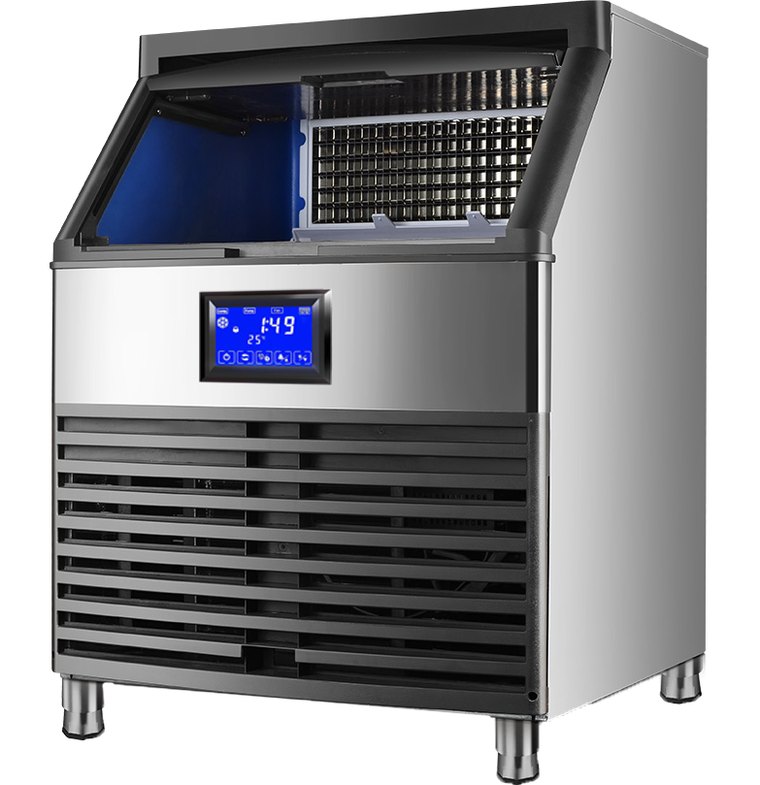
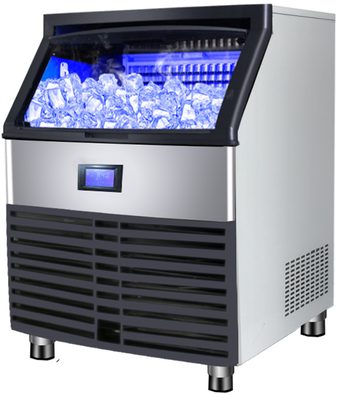
Six integrated units that fit under a counter and drop ice straight into a built-in bin.
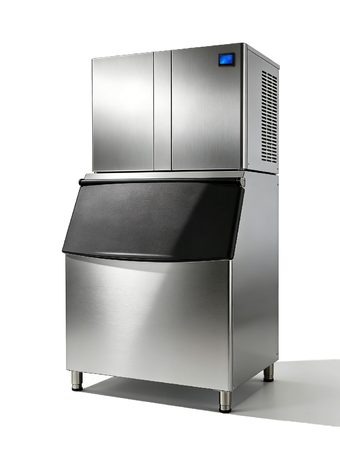
Eight modular units that stack on a separate bin and go up to 1,000 kg/day.
Same ice, two ways to install it.
Machine and ice bin in one cabinet. Roll it in, plug it in — nothing else to buy.
Model
Output kg/24h
Power W
Cells
Cells total
W×D×H mm
Bin kg
Voltage
OLC-80P
40
352
5×9
45
500×450×785
15
220V
OLC-100P
60
374
5×12
60
500×450×785
15
220V
OLC-120P
70
385
5×14
70
500×450×785
15
220V
OLC-175P
80
418
5×18
90
660×680×930
35
220V
OLC-210P
100
440
6×18
108
660×680×930
35
220V
OLC-300P ★
130
616
7×18
126
660×680×930
35
220V
All models 220V / 50Hz · bin capacity and cell count on each model page.
Bin capacity is built into the cabinet. OLC-300P is the largest integrated unit — 130 kg/day in a 660×680 mm footprint.
Modular 8 MODELS · 160–1,000 KG
Head sits on a separate bin. Pick the bin size your site needs.
Model
Output kg/24h
Power W
Cells
Cells total
W×D×H mm
Bin kg
Voltage
OLC-350P
160
732
12×13
156
560×830×1660
100
220V
OLC-450P
200
748
13×14
182
560×830×1660
100
220V
OLC-500P
250
980
13×18
234
760×830×1720
150
220V
OLC-700P
300
1,138
17×18
306
760×830×1860
150
220V
OLC-800P
350
1,300
18×19
342
760×830×1860
150
220V
OLC-1000P ★
500
1,740
19×21
399
760×830×1860
150
220V
OLC-1500P
750
2,800
18×19×2
684
1220×960×1945
450
220V
OLC-2000P ★
1,000
3,800
19×21×2
798
1220×960×1945
450
220V
All models 220V / 50Hz · bin capacity and cell count on each model page.
Bin capacity shown is the matching storage bin, not built into the ice maker head.
Dimensions are for the ice maker head. OLC-1500P and OLC-2000P use a twin-evaporator head — that is what the ×2 in the cell count means.
Integrated or modular — the decision is about your space, not the ice
Both make the same cube. What differs is where the ice lands and how much room you have.
INTEGRATED
One cabinet, nothing else to buy
OLC-80P → OLC-300P · 40–130 kg/day
Ice bin is inside the body — 15 to 35 kg of ready ice
500×450 mm footprint fits under a standard counter
Single 220V plug, no separate bin delivery
Best for cafés, bars, small restaurants, staff kitchens
MODULAR
Head on a bin, capacity you can size
OLC-350P → OLC-2000P · 160–1,000 kg/day
Ice maker head sits on a separate bin — 100 to 450 kg
Bin can be swapped for the size your daily use needs
Head can also discharge into an ice room or conveyor
Best for processing, supermarkets, central kitchens, distributors
What the cell count actually tells you
A cube machine does not run continuously. It freezes a grid of cells, releases the whole grid, then starts again.
5×9 = 45 means five rows of nine cells: 45 cubes drop in one harvest.
More cells means a bigger drop per cycle and fewer cycles per day. That is why output and cell count rise together —
and why a machine with more cells handles peak demand better than one that simply runs longer.
The grid is filled by water flowing across the open tops of the cells, not by
a still tank. The pump keeps the film moving through the whole freeze cycle, so air and sediment are carried
away before they can set: a cube frozen in still water goes cloudy in the middle, and a cloudy cube cracks
when someone tries to carve it.
OLC-210P grid shown · 6 rows × 18 cells = 108 cubes per harvest.
Twin-evaporator models (1500P / 2000P) run two of these grids at once.
Where these machines end up
Cube ice is the default for anything that goes into a glass or onto a display. These are the six applications we ship to most.
Every model on this page is built in our own plant in Jiaxing — not sourced per order.
9
Ice types in-house
Cube, flake, nugget, granular, snow, crescent, large cube. One supplier for a mixed order.
CE
& ISO 9001
Certified production. Certificate coverage confirmed per model before you quote it.
12h
Reply, in English
Spec sheets, FOB pricing and lead time answered by the sales team, not a form robot.
Questions buyers ask before ordering
How do I know which capacity I need?
Add up how much ice you actually use on your busiest day, then add 20–30% headroom. A restaurant seating 80 typically lands at 100–160 kg/day; a seafood counter packing daily lands at 300–500 kg.
Rated output is measured at 15–25 °C ambient — in a 40 °C kitchen or a Gulf summer, expect less than the nameplate figure. Tell us your site temperature and we will size it against that, not against the datasheet.
What is the difference between integrated and modular, in practice?
Integrated: the bin is inside the machine, so you buy one item and it holds 15–35 kg of ice. Modular: the head sits on a separate bin holding 100–450 kg, so you can match storage to your peak rather than your hourly output.
If your staff empties the bin faster than the machine refills it, go modular.
Do all models run on 220V?
All 14 cube models are 220V / 50Hz single phase. The largest, OLC-2000P, draws 3,800 W — confirm the site has a circuit that can carry that before ordering.
For 380V three-phase, our flake and snow ranges have 380V options; ask us to check for your destination.
Can I get 50 Hz or 60 Hz, and other plug types?
Yes. Voltage, frequency and plug are set at build time, so tell us the destination country when you request the quote. Middle East and most of Asia take 220–240V / 50Hz;
some export markets need 60Hz, which we build to order.
Is CE certification on every model?
Our production is CE and ISO 9001 certified, but we do not claim every individual model carries its own CE certificate.
Tell us the models you intend to import and we will confirm certificate coverage in writing before you commit — this matters if you are bidding into a tender.
Tell us the output you need. We will name the model and the price.
Send your daily ice requirement, site voltage and destination port. You get a model recommendation, FOB price and lead time — usually within 12 hours on a working day.