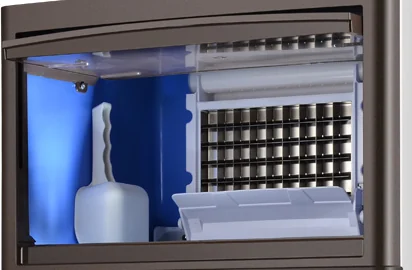
Spray-built cells freeze the cube from the surface inward, so the finished cube stays clear and hard instead of turning white in the middle. Two cell sizes — 30×30 mm and 50×50 mm — across five models. The cell size is set when the machine is built, so you choose the model, not a setting on it.

All air-cooled, 220V single phase, storage bin included.
30×30 or 50×50 mm · fixed per model · power, bin and cell count on each model page.
† OLC-PL210P appears twice on purpose. It is the one model built with either cell size — same cabinet, same 100 kg output, different cube: 70 cells at 30 mm, or 24 cells at 50 mm. Because the cell plate is fitted on the line, tell us which size you need before the order is released.
Bin capacity is the storage bin supplied with the machine. Dimensions cover the complete unit, not the refrigeration deck alone. 250 kg is the largest single large-cube unit we build — above that, buyers run two OLC-PL500P in parallel, so one keeps producing while the other is serviced.
This is the only real decision on this page. Both are clear, both are hard. What changes is how fast the cube melts and how fast it chills a drink.
A 50 mm cube holds about 4.6 times the volume of a 30 mm cube but only 2.8 times the surface. Less surface per gram means slower melting, which in a glass means slower dilution — the reason a whiskey bar will not use a small cube. Turn it around and a 30 mm cube chills a drink faster, because the same weight of ice touches the liquid with far more surface area.
Volumes: 30 mm cube ≈ 27 cm³, 50 mm cube ≈ 125 cm³ — a ratio of 4.6. Surface: 5,400 mm² versus 15,000 mm² — a ratio of 2.8. That gap is the whole difference between the two cell sizes.
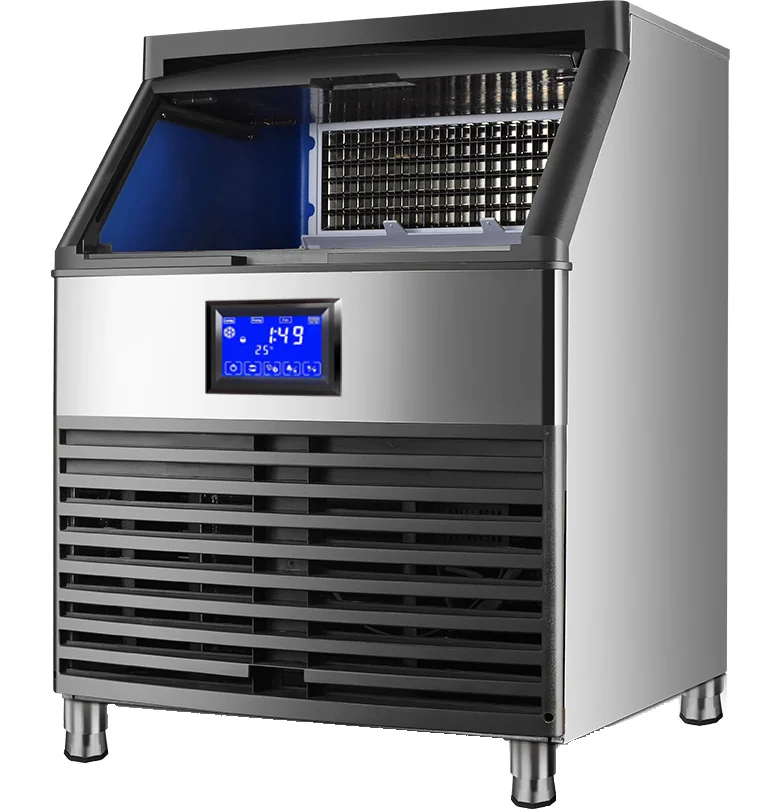
Most low-cost large-cube machines work by lowering the cell plate into a tank of still water. Air dissolved in that water has nowhere to go, so it freezes into the cube — which is why those cubes come out white in the middle and crack when someone tries to carve them.
Ours sprays water across the face of the cell from above. The flow keeps moving, so air is carried away before it can be trapped in the ice. The cube freezes layer by layer from the outside in, and what comes out is clear, dense and hard — it also melts more slowly than a cloudy cube of the same size.
The machine removes air, not minerals. If your water is hard, put a filter in front of it — that is the one thing outside our control, and it is the first thing a bar manager notices.
Large cube is a presentation product, not a bulk commodity. These are the six buyers who order it.
The one application where melt rate is a spec, not a detail. 50 mm, and cell count matters less than clarity.
See recommended models → 02Consistent cube across several outlets, and a machine that does not need a plumber on call.
See recommended models → 03Clear ice is the whole point — cloudy ice shatters under the chisel. Volume has to be sized to the event calendar.
See recommended models → 04Large cube melts slowly, so the display bed stays cold without drowning the product in melt water.
See recommended models → 05250 kg a day covers a market stall or a small bagging operation. Above that, run two units.
See recommended models → 06Peaks, not averages. Size on the biggest weekend of the month, then hire the rest in.
See recommended models →Every machine on this page is built in our own plant in Jiaxing — not sourced per order.
Cube, flake, nugget, granular, snow, crescent, large cube. One supplier for a mixed order.
Certified production. Certificate coverage confirmed per model before you quote it.
Spec sheets, FOB pricing and lead time answered by the sales team, not a form robot.
If the ice goes into a glass of spirits, take 50 mm: it melts slower, so the drink is not diluted before the customer finishes it. If the ice goes into a shaker, an iced coffee, a display bed or a bag, take 30 mm: it chills faster and you get more cubes per harvest for the same daily output. If you serve both, OLC-PL210P is the model that can be built either way — order one of each.
No. The cell plate is a manufactured part, not a setting — changing it means changing the plate and the harvest cycle. This is why we ask for the cell size on the order and print it on the confirmation. It is also why we do not put a size selector on the page: the size is the model.
The spray system is what makes it possible — it removes the air before it freezes in. What the machine cannot fix is your water. Hard water leaves minerals that cloud the cube and scale the plate, so a filter ahead of the machine is part of the installation, not an accessory. Ask us and we will tell you what the water needs to be.
For large cube we build up to 250 kg per unit, and we will not quote you a bigger single machine we do not make. Above that, two OLC-PL500P in parallel is the normal answer: two 560×830 mm footprints, one keeps producing while the other is cleaned or serviced, and you can add the second unit a season later instead of paying for all of it now.
Yes — every dimension on this page is the complete unit with its bin, not the refrigeration deck on its own. If you are cutting a counter or building a recess, work from these figures and leave the clearances in the installation drawing we send with the order: the machine needs air at the front and access at the back.
All five models are 220V / 50Hz single phase as standard; the largest draws 1,240 W, which a normal kitchen circuit carries. Other voltages and 60 Hz are set at build time — tell us the destination. Production is CE and ISO 9001 certified; tell us the models you intend to import and we confirm certificate coverage in writing before you commit. Standard lead time is quoted per order, because it moves with the shipping schedule.
Send your cell size (30 or 50 mm), daily requirement, site voltage and destination port. You get a model recommendation, FOB price and lead time — usually within 12 hours on a working day.